Meteora in Thessaly
The six houses
Twenty-four monasteries once stood on the rocks. Six stand today. One traveller saw or tried the door of every one of them in two days.
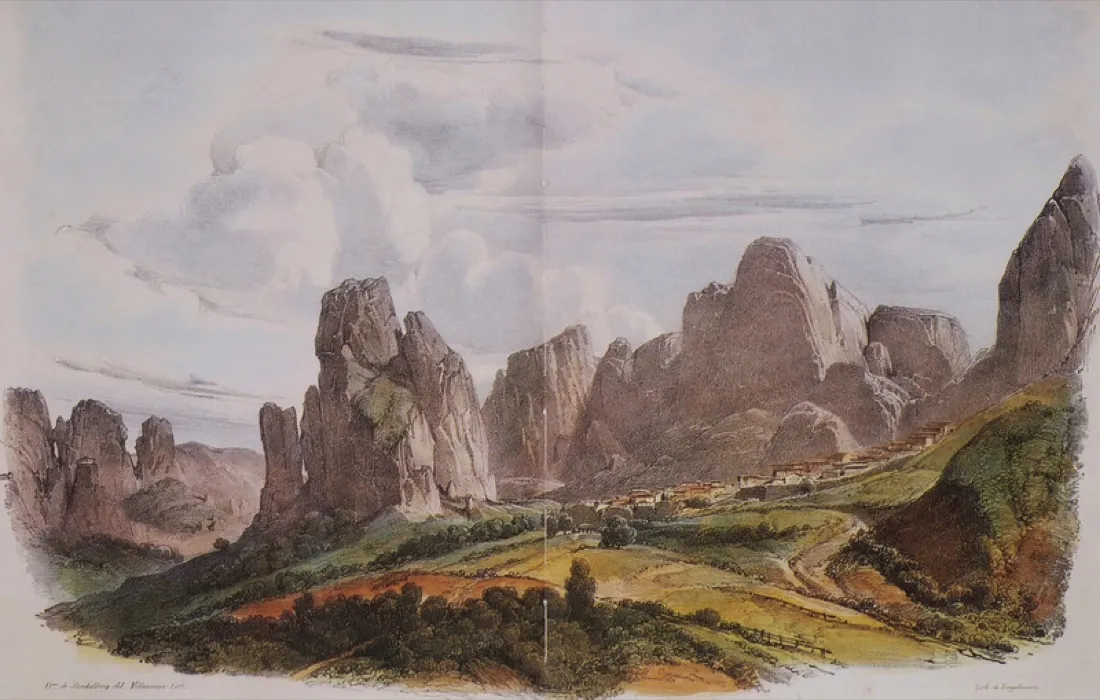
Meteora means the things hung in the air. The rocks stand at the edge of the plain of Thessaly, above the town of Kalabaka, and by the end of the fifteenth century there were twenty-four monasteries on their tops. Robert Curzon, who came in the days of the nets, counted seven still kept. Six remain now, and since 1988 they have been on the World Heritage List.
They are living houses of prayer. What follows is not a guide to visiting them, for which each house's own word is the only one to trust. It is what Curzon found at each door, set beside the corner of the Sky Monastery that remembers it.
The Transfiguration of the Saviour
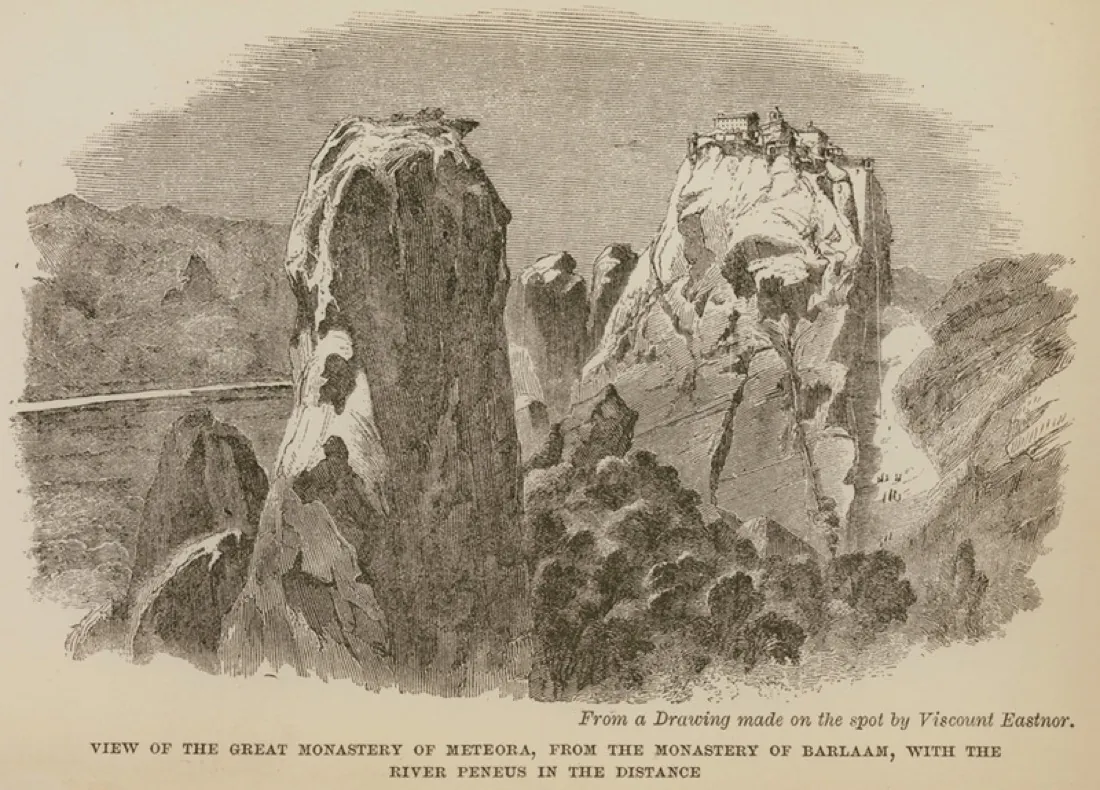
The Great Meteoron
The oldest and the largest, founded by Athanasios the Meteorite in the middle of the fourteenth century. Curzon was drawn up twenty-five fathoms in the net and unpacked before the whole community. He thought it in better order than the others, with about twenty monks in a house built for three times as many, a church more brilliant with gold than Barlaam's, a library hidden behind a cupboard, and a kitchen that was all chimney.
In the Sky Monastery: the katholikon bears the same dedication.
Stand in the church › Read the church ›All Saints
Varlaam
Curzon's Barlaam, within sight of the Great Meteoron. Here he watched his servants go up thirty-seven fathoms in the net, climbed the ladders himself, and dined the old abbot on sherry and sweets. He found fourteen monks on an acre and a half of summit, with the church, a chapel, the refectory, the kitchen and the tower of the windlass round one paved court.
In the Sky Monastery: the winch tower and its net.
Stand at the windlass › Read the ascent ›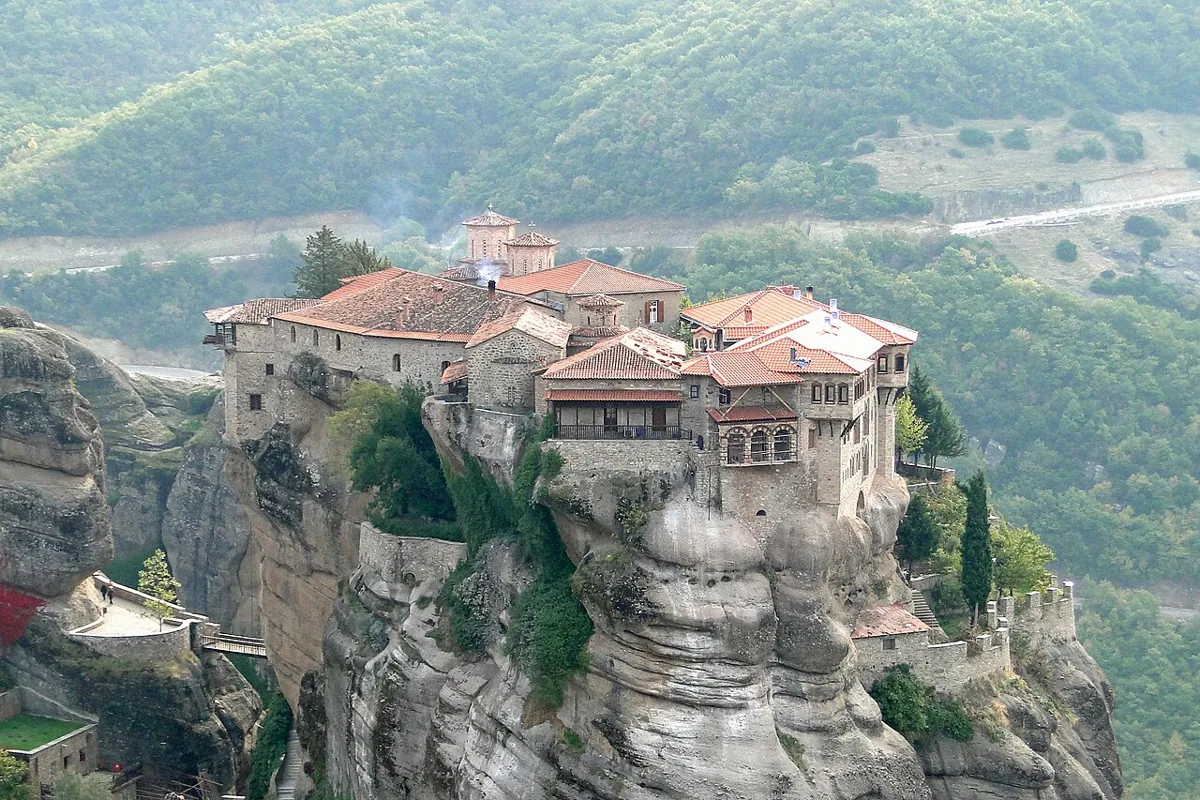
Varlaam. Photograph by Bernard Gagnon, 2011, CC BY-SA 4.0.
Hagios Stephanos
St Stephen
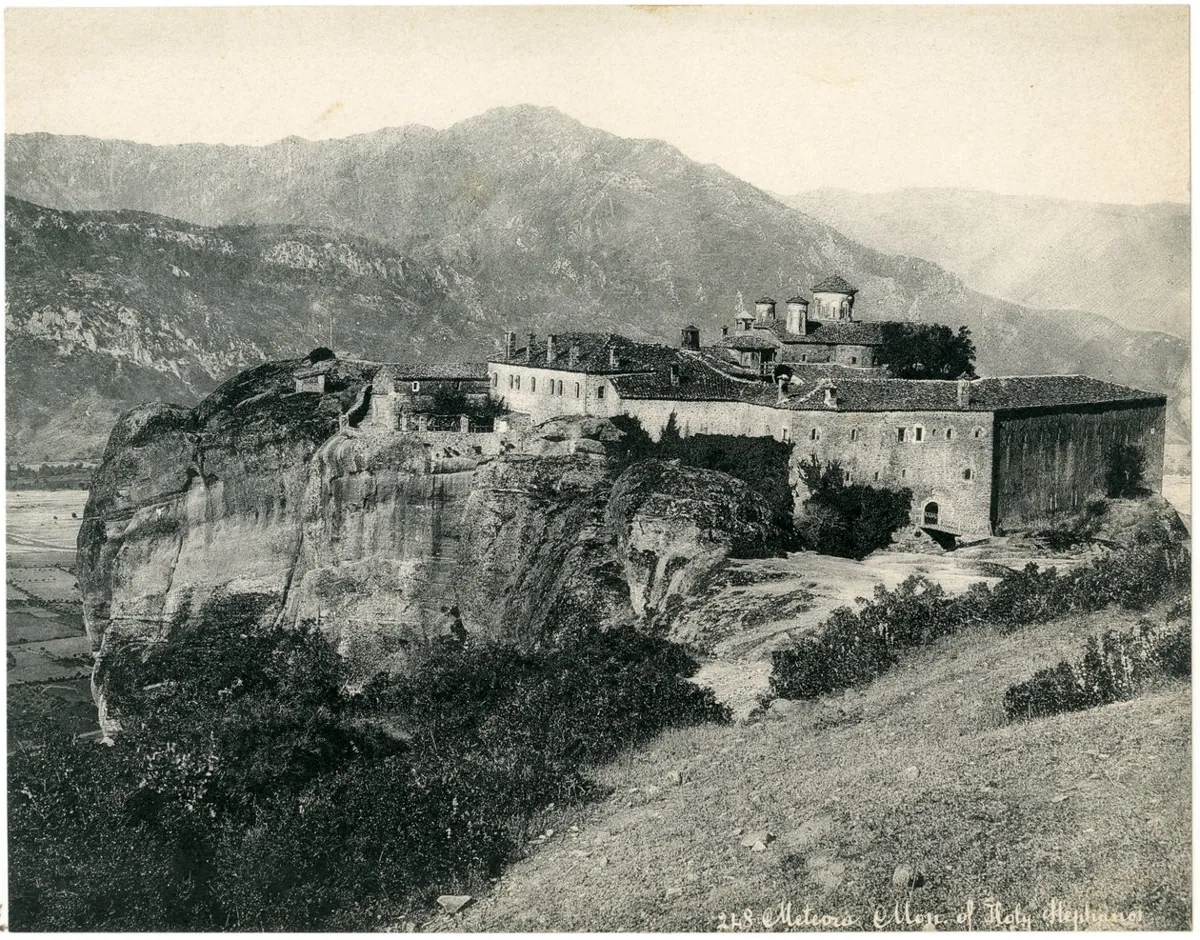
The one house that needed no net. Its rock is cut off from the mountain by a chasm only twelve feet wide where Curzon crossed it, by a wooden drawbridge. Inside he admired a screen of icons carved with foliage, birds and flowers “in the most delicate manner”, was shown a library behind a second cupboard door, and looked out over Kalabaka and the plain to the snow of Mount Olympus.
In the Sky Monastery: the lookout bastion and its cross.
Stand at the lookout ›The monastery of St Stephen, about 1890. Public domain.
Agia Triada
The Holy Trinity
A single tall pillar with the monastery on its crown. Ten or twelve monks pulled Curzon up to their door with a rope thirty-two fathoms long. He found a place like a small village, its houses huddled round a little painted church, a hundred musty books and no manuscripts, paid his respects to the bearded saints on the chapel walls, and was let down again.
In the Sky Monastery: the walkway cut along the cliff.
Stand on the cliff walk ›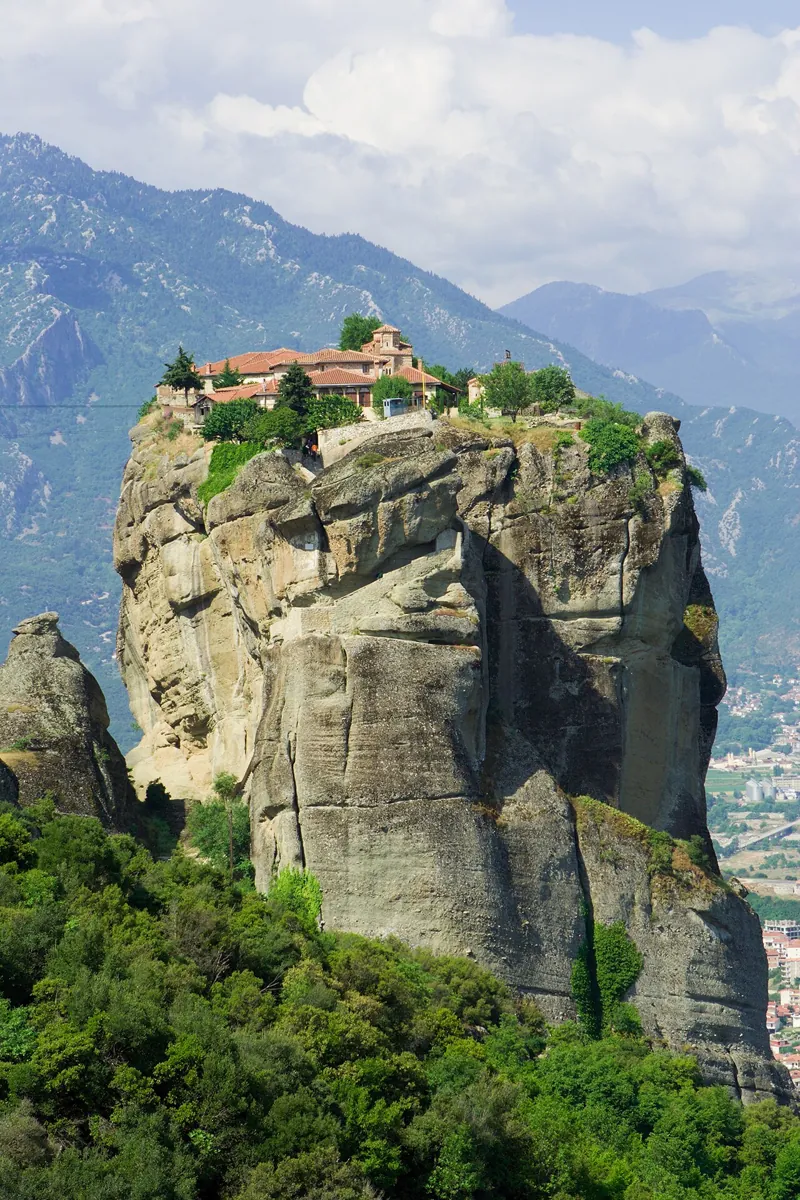
The Holy Trinity. Photograph by Dido3, 2007, CC BY-SA 3.0.
Curzon's Hagia Roserea
Roussanou
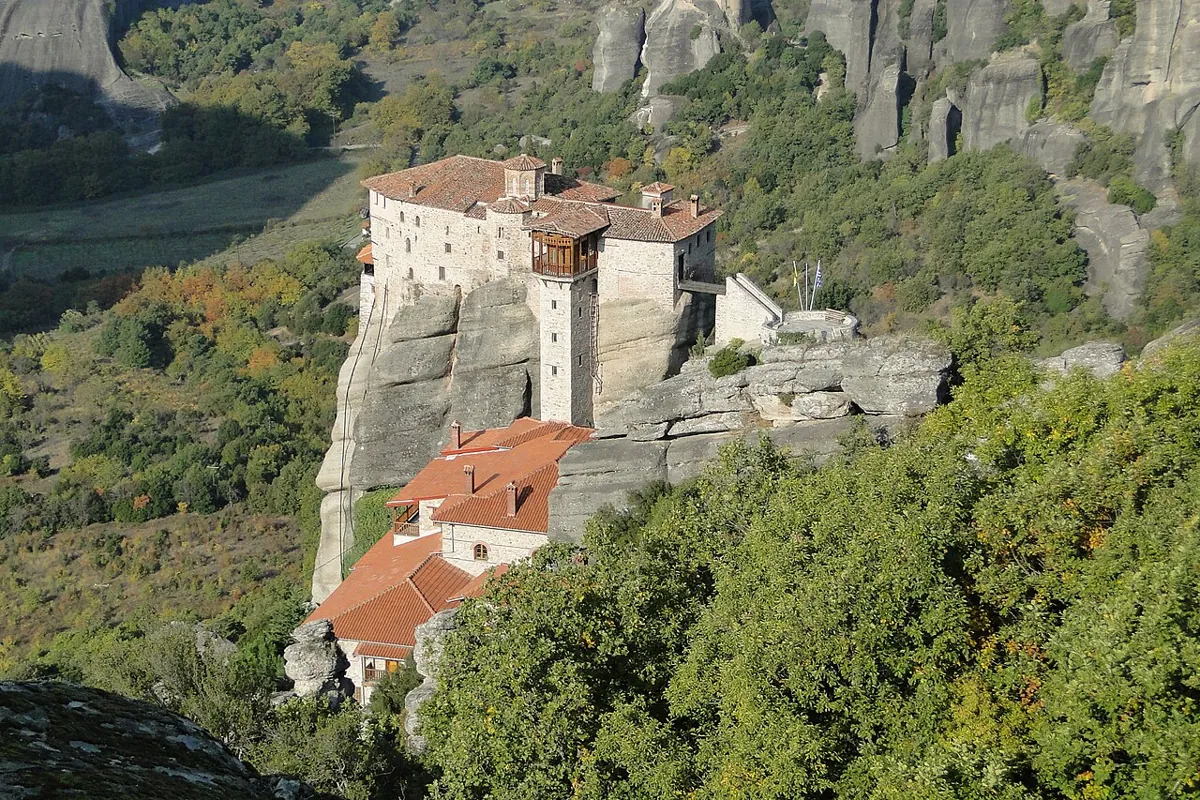
A rock so small, Curzon wrote, that the buildings cover the whole of its summit and leave no room for a garden. The monks were out. Two old women came onto a wooden balcony overhead, declined the honour of his visit, and would not let down the rope ladder, which hung drawn half way up. He tried compliments and then insults, and walked off in high indignation. It is a house of nuns today.
In the Sky Monastery: there is room for a garden square, with a fountain in it.
Stand in the garden square ›Roussanou. Photograph by Bernard Gagnon, 2011, CC BY-SA 4.0.
Very likely Curzon's Hagios Nicholas
St Nicholas Anapafsas
Curzon never climbed to it. From St Stephen he saw the village of Kalabaka lying black below, lately burned and sacked by robbers, and was told that what remained of its people had taken refuge in two monasteries the monks had left some time before, Hagios Nicholas among them. They were in such alarm that they would admit no stranger. A monastery on a rock was, before anything else, a place that could not be taken.
In the Sky Monastery: the great gate is barred each night.
Stand at the gate ›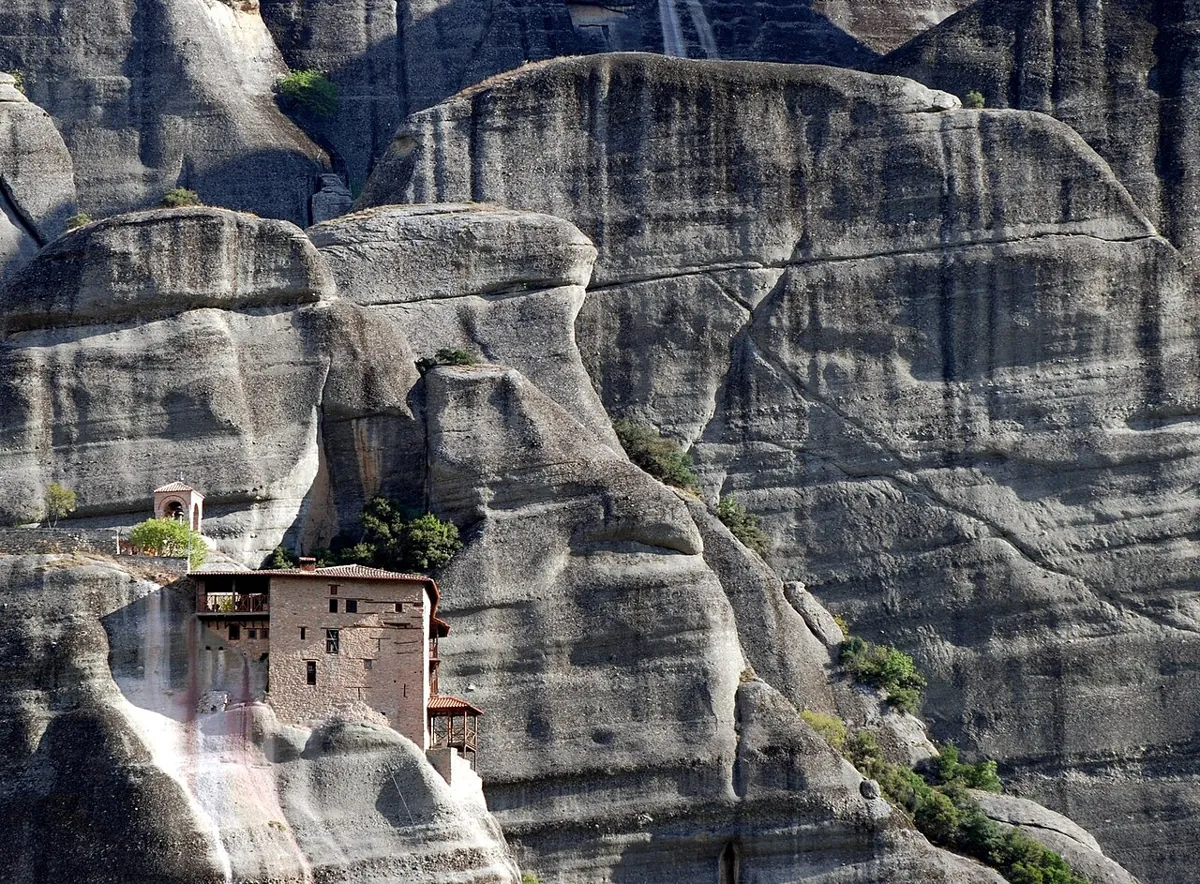
St Nicholas Anapafsas. Photograph by Takeaway, CC BY-SA 3.0.
What is invented. Only the Sky Monastery. The six houses are real, and the days described are Curzon's own; his spellings are given beside the names used now.
Where this comes from. Robert Curzon, Visits to Monasteries in the Levant (London, 1849), chapters XIX and XX, pp. 279–309, in the public-domain scan at the Internet Archive. The count of twenty-four monasteries, the founding of the Great Meteoron, the World Heritage listing of 1988 and Roussanou's present use as a convent are from the articles on Meteora and its monasteries at Wikipedia [these, and the present state of each house, want a better source].