The third essay
The bones
A monk is buried twice: once in the earth, and three years later on a shelf among his brothers, with his name written on his brow.
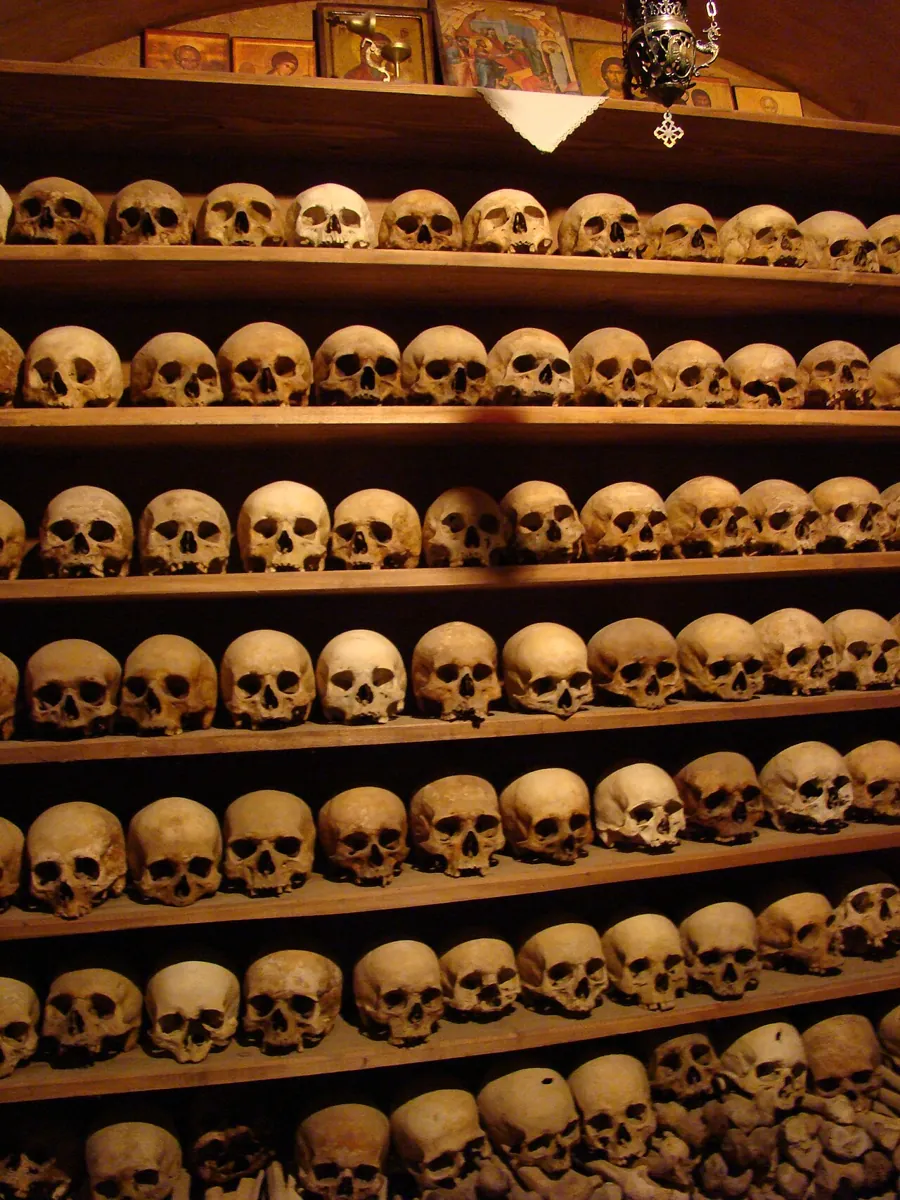
A rock has little earth on it. A house that has stood for centuries on a summit of an acre or two has buried many more brothers than it has graves for, and the Greek monasteries answered that long ago. The grave is lent, not given. When its time is up the brother's bones are lifted, and the grave is ready for the next.
Visitors to the Great Meteoron are shown the result today: a room where the skulls of the monks who lived on the rock stand in rows on wooden shelves, under a lamp. It is not a curiosity to the brethren. It is where their predecessors are, and where they will be.
Three years in the earth
The fullest old account in English comes from Mount Athos, the monks' peninsula in the north of Greece. Athelstan Riley travelled there and published what he saw in 1887. From his window at the monastery of Vatopedi he could see the cemetery, and wondered how so small a plot served so many.
“…the invariable custom which prevails here, and generally amongst the Greeks, of digging up the bodies three years after burial; the skulls are then neatly labelled with the names of the owners and the dates of their deaths, and placed in the crypt of the cemetery church, whilst the other bones are thrown confusedly into a large chest. The crypt at Vatopedi contains 3,000 skulls.”
The dead were buried without coffins, he adds, and another brother was laid in the same place when the first was lifted.
In the house, at this hour
The ossuary
Under the lite lie the fathers' bones after their three years in the earth. Each skull is on the shelves with his name and the year written on the brow, and the long bones lie in the bins below.
Stand there now ›Shelves, clean and nicely painted
At the Russian monastery on Athos, where three hundred monks ate their dinner of vegetables in silence, Riley was taken to the burial ground, about twenty yards square, and to its little church. It stood on a hill just outside the walls, and he could see from his window monks constantly going up to it.
“On one side of the church are long shelves of a considerable depth, clean and nicely painted, and on these skulls of departed brethren are neatly arranged, to the number, we were told, of 1,500. On another side arm and leg bones are stacked, and at the entrance stand two great boxes about half full of the smaller bones.”
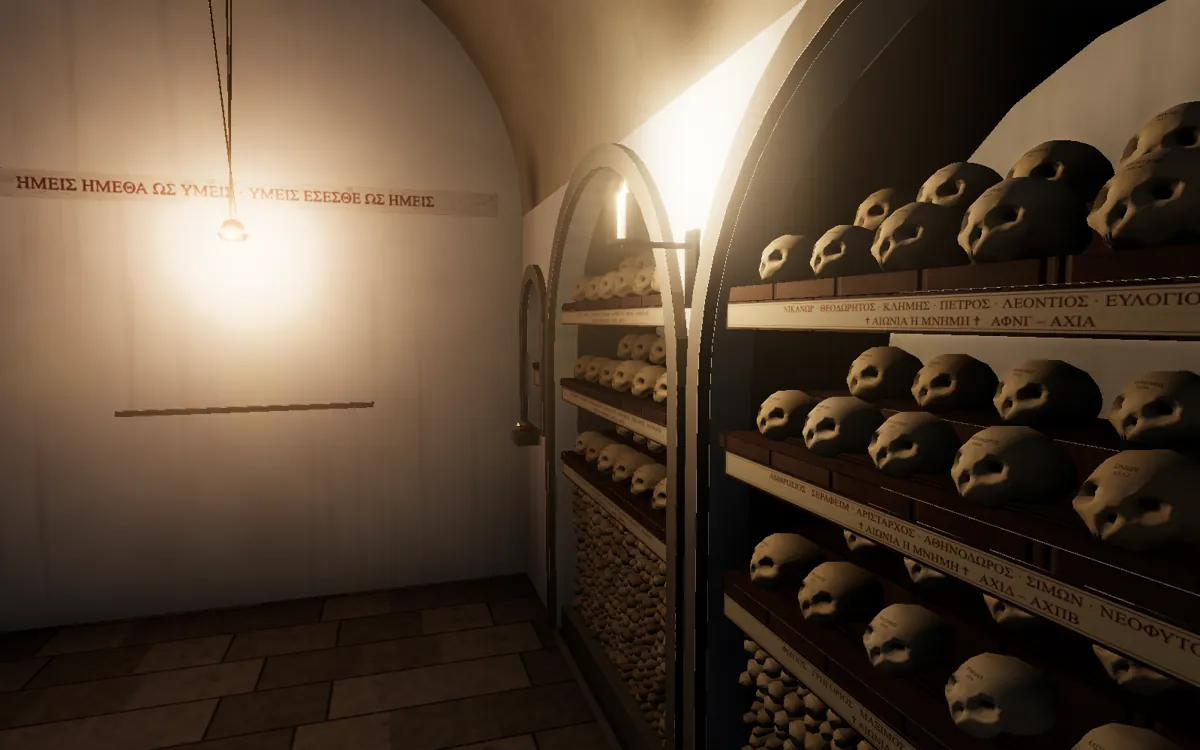
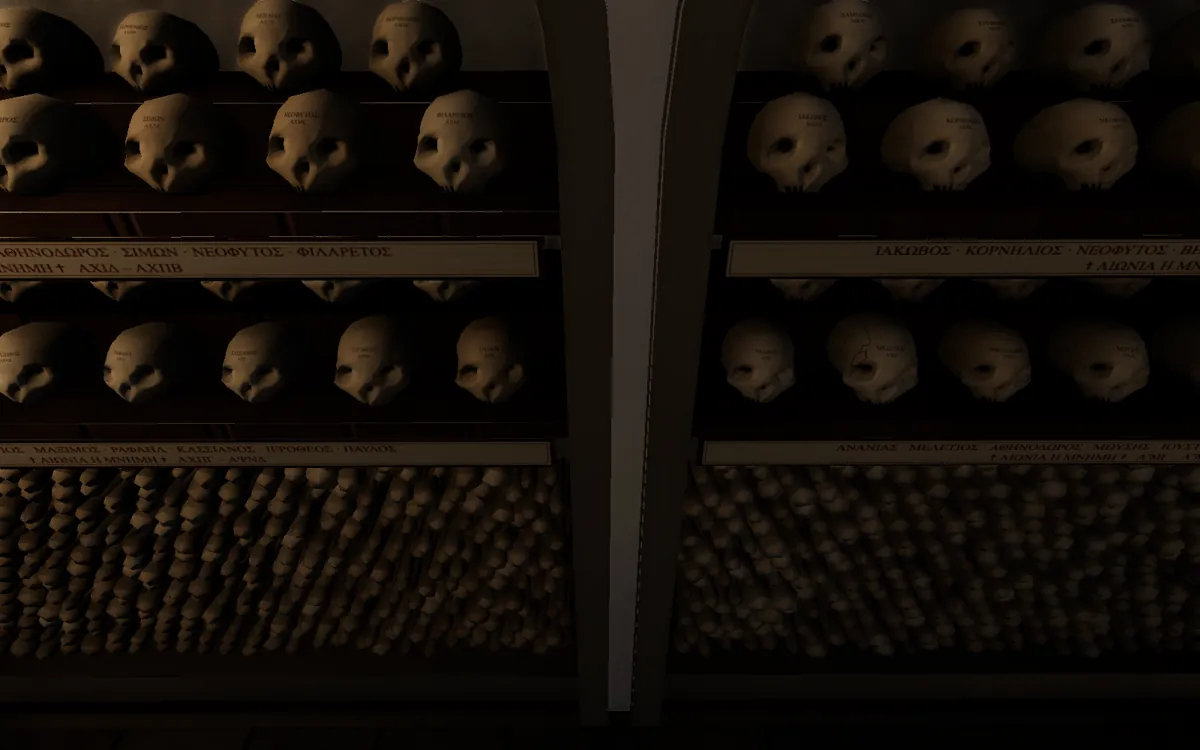
The ossuary of the Sky Monastery is laid out the same way. A single limewashed vault runs under the lite of the church, and its west wall is cut back into six arched niches. One hundred and seventeen fathers stand on dark oak shelves in the order of their years, a front rank and a back rank, and the long bones are stacked in the bins beneath. Eight hegumens have a niche of their own behind an iron grille, each on his red stole. The north bay is filled to its arch with the bones of those whose names are gone.
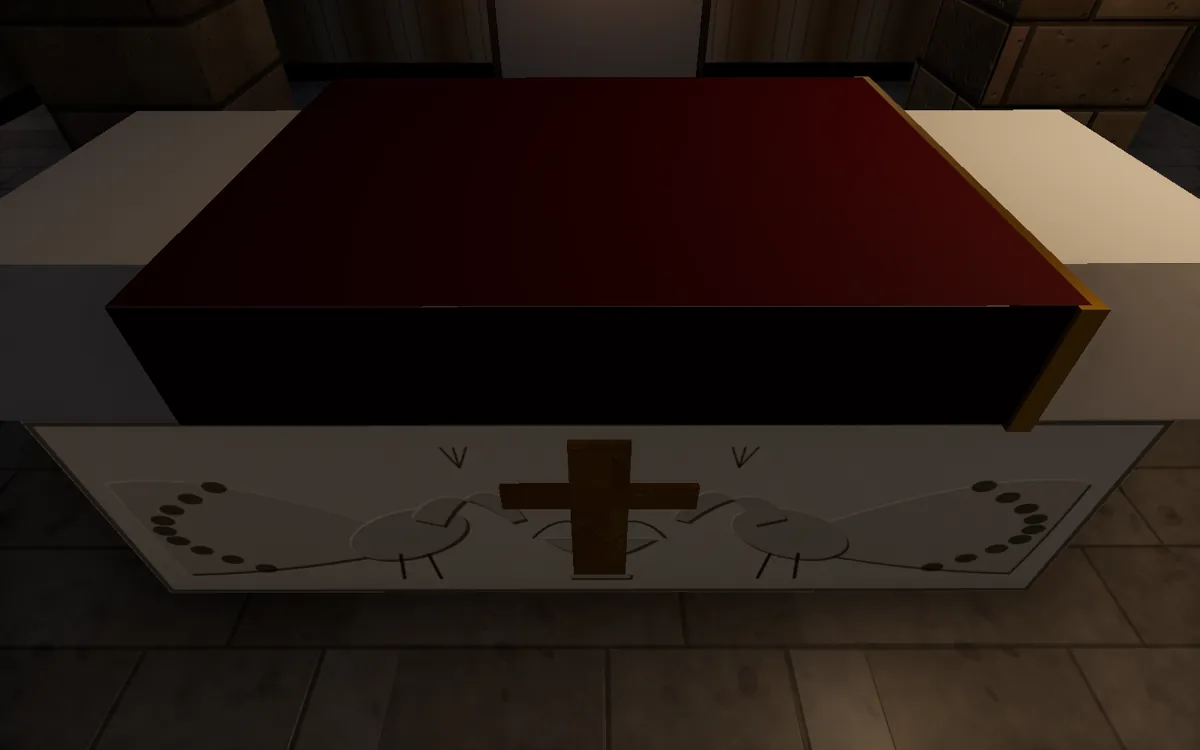
A name on the brow
In another cemetery chapel on the Mountain, at the Serai, the skulls were piled in rows, each labelled with the name and age of its owner and the date of his death. Some were kept in little wooden boxes with lids. The priest who showed Riley round opened one.
“…one of these skulls Philemon took out of its receptacle and handled lovingly. He gave us to understand that it belonged to a great friend of his, who had died three years back; and there upon the bleached forehead was written his name. The good priest heaved a little sigh, put the skull back into its box, crossed himself, and led us out of the chapel.”
The Sky Monastery writes the name and the year on the brow in the same way. By the east wall of its ossuary stand a stone basin, a copper jug and a folded linen cloth, for the house washes a brother's bones in wine before it sets him on the shelf. The bier leans beside the door.
Remember your end
Riley, an Englishman, called the bone houses barbarous before he defended them:
“It is the fashion to labour to forget death and to live as much as possible in the present; but to call before our eyes our own death-beds each time we hear a passing bell, to cultivate the thought of our own dissolutions whenever we hear of a friend's departure or look upon a sepulchre—these are not dangerous and morbid exercises, but rather pious and laudable customs…”
The house on the Broad Rock says it more shortly. Over the door of its ossuary, on the side a brother sees as he goes in, is cut in Greek: Remember your end. On the wall facing him, over the icon of the Resurrection and its lamp: We were as you are; you will be as we are. A stone bench runs along the east wall, where anyone may sit with the fathers.
At the south end of the wall is a small niche with an empty oak shelf, the oldest name-plate in the room beneath it, Abba Elias's, and a clay lamp that is always lit. Why his place stands empty is a question the house leaves for its guests.
In the house, at this hour
The vestibule of the tombs
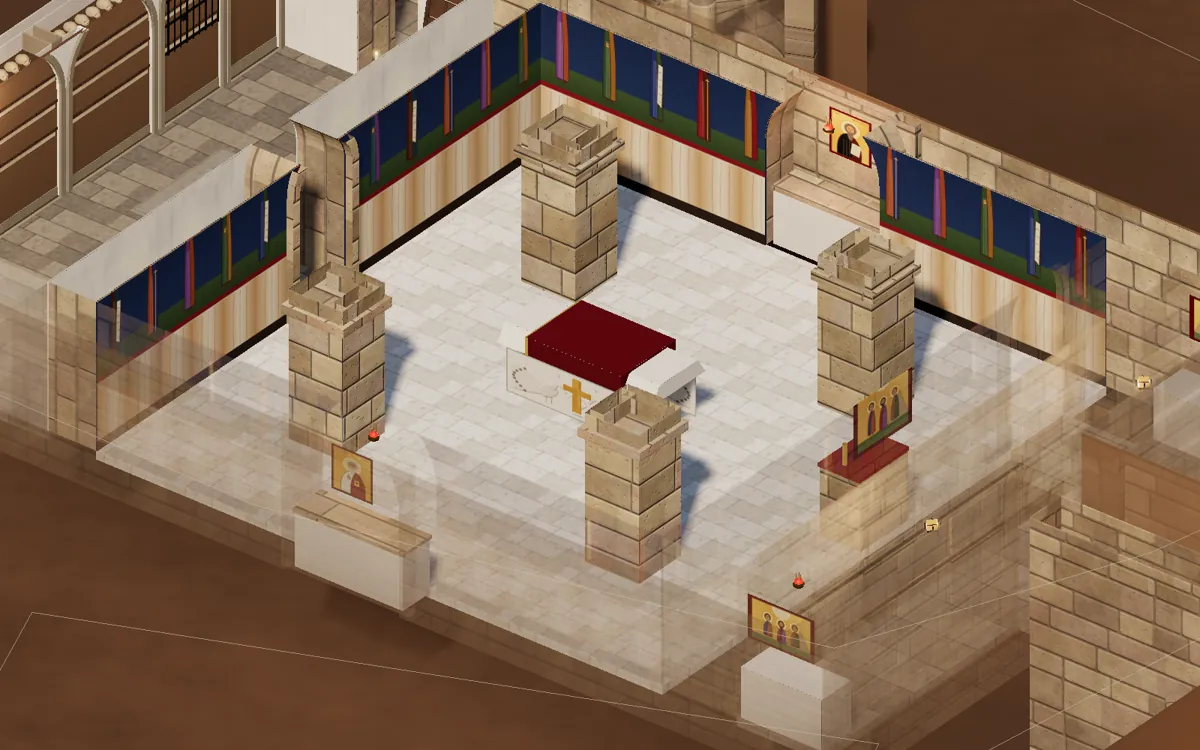
A low vaulted room at the foot of the round stair under the church. A lamp burns before the diptychs, the books of the names of the departed, read at every memorial.
Stand there now › Or go on to the crypt ›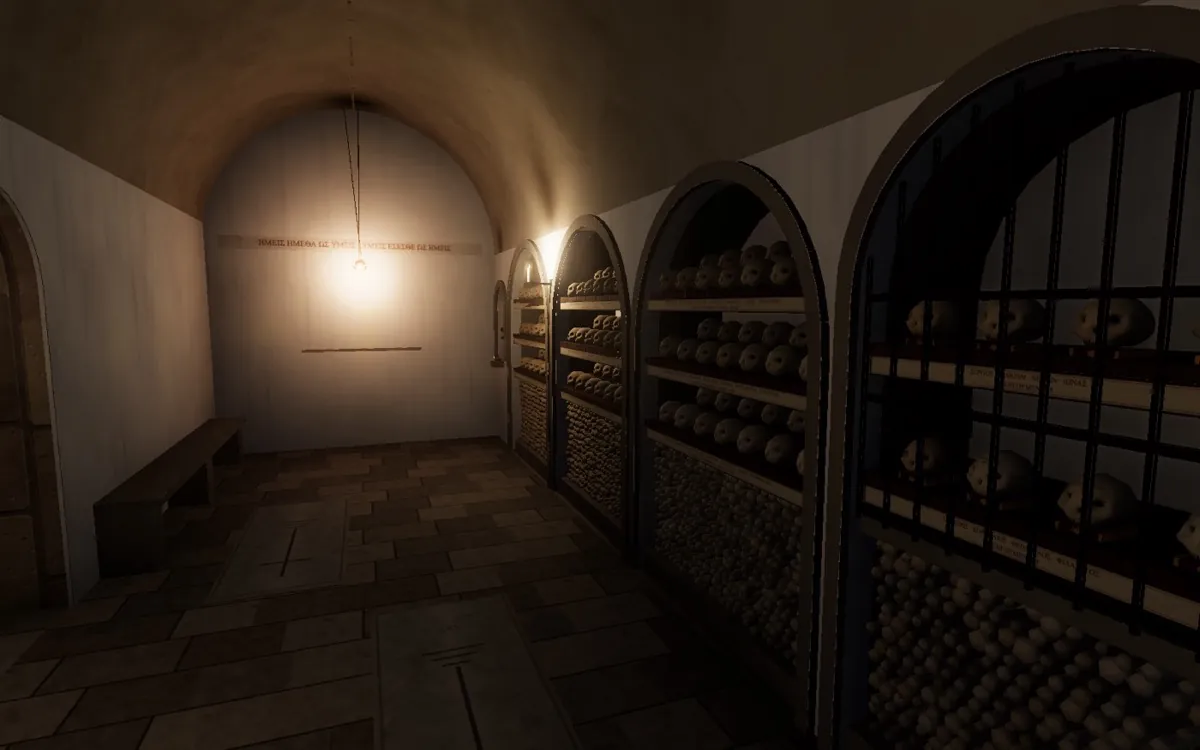
What is invented. The ossuary, the crypt and every father named in them belong to the Sky Monastery, as do the two inscriptions and the empty shelf. The custom is real, and so are the shelves of the Great Meteoron.
Where this comes from. Athelstan Riley, Athos, or the Mountain of the Monks (London, 1887), pp. 47–48, 254 and 280, in the public-domain scan at the Internet Archive. Riley describes Mount Athos, not Meteora; that the same custom is kept on the rocks rests here on the ossuary shown to visitors at the Great Meteoron [a written source for the custom at Meteora itself is still to be found].
 The next essayThe hours ›A board of good wood and a mallet, the bells, and the call at midnight.